blog · platform · 4 august 2026 · 5 min read
What is a PAM?
The operational core behind player accounts, wallets, controls and the data that keeps an iGaming platform connected.
Players see games, odds, promotions and payment methods.
Behind those experiences sits a set of systems responsible for knowing who the player is, what their account status is, what they can access and what has happened throughout their relationship with the operator.
At the centre of that environment is often the Player Account Management system, or PAM.
For operators, the PAM is one of the most important parts of the technology stack.
What does a PAM do?
A PAM creates and maintains the player account.
When someone registers, the platform needs a reliable record that follows that person throughout their lifecycle.
Depending on the architecture, the PAM can manage or coordinate information such as:
- registration details
- account status
- verification status
- restrictions and limits
- wallet information
- transaction history
- bonus eligibility
- segmentation
- currency and market settings
This makes the PAM much more than a database of registered players.
It is an operational layer that connects the player account with the systems required to run the business.
For operators running casino, sportsbook or several brands, that common player identity becomes especially important.
PAM vs the wider platform.
PAM and iGaming platform are sometimes used interchangeably, but they are not quite the same thing.
The PAM focuses on the player account and the processes surrounding it.
The wider platform can include the PAM together with:
- wallets
- payments
- gaming integrations
- promotions
- CMS
- reporting
- compliance tooling
- back-office functionality
- third-party integrations
What matters to an operator is not simply whether each component exists.
It is how well they work together.
An account restriction changed in one place may need to affect payments, gaming, promotions and responsible gaming controls.
When systems cannot exchange that information reliably, operational complexity increases quickly.
The wallet.
The wallet is closely connected to the PAM, but it performs a different job.
The PAM knows the player.
The wallet keeps track of the financial value associated with that player.
Deposits, withdrawals, wagers, wins, bonus credits, refunds and adjustments can all result in movements that need to be recorded accurately.
Behind the balance shown to the player should be a transaction history capable of explaining how that balance was created.
For operators, this is essential for reconciliation and day-to-day financial operations.
Wallets and payments are different.
The wallet should also not be confused with the payment provider.
A payment provider handles the external movement of funds through cards, bank transfers, mobile money, e-wallets or other payment methods.
The platform wallet records the corresponding financial event internally.
Those two layers need to remain aligned.
Pending transactions, failures, reversals and duplicate requests all need to be handled without leaving the player's internal balance in the wrong state.
The back office.
The front end is what the player sees.
The back office is where operational teams manage much of what happens behind it.
Different teams may use the same environment for very different purposes.
Customer support can review player activity. Finance can investigate transactions. Product teams can manage settings. CRM teams can work with promotions and segmentation. Compliance teams can review verification and account controls.
This is why back-office usability matters.
Powerful technology is less useful if everyday tasks require unnecessary steps, manual work or constant developer support.
Permissions and audit trails are equally important. Teams need access to what they are responsible for, without unnecessary access to sensitive areas.
CMS and frontend.
The CMS gives authorised teams control over player-facing content.
That can include navigation, banners, game categories, market-specific content, languages and promotional areas.
The frontend is the actual interface the player uses.
Some operators want the platform provider to deliver the complete experience. Others want more control over the player-facing product.
Both models can work.
The important question is whether the underlying platform can support the operating model the business wants to build.
PAM and CRM.
A PAM and CRM also serve different purposes.
The PAM provides the operational player record.
A CRM typically uses account and behavioural data to manage communication, segmentation and lifecycle engagement.
They need to exchange information reliably.
If the PAM records that a player is restricted or has changed account status, downstream systems should not continue acting on outdated information.
Clear ownership and synchronisation of data become particularly important as the number of connected systems increases.
Compliance and player controls.
Player accounts can also connect with processes such as identity verification, Know Your Customer checks, account restrictions, self-exclusion and responsible gaming limits.
Requirements differ between jurisdictions.
An operator entering a second market may therefore need different registration rules, limits, payment configurations or verification processes.
A flexible platform should allow these differences to be managed without creating an entirely separate technology stack for every market.
Technology does not replace the operator's regulatory responsibilities. It should make those responsibilities easier to manage consistently.
Reporting starts with consistent data.
Every player interaction creates operational data.
Registrations, deposits, gaming activity, withdrawals, bonuses and account changes all contribute to the wider picture.
Useful reporting depends on those events being connected to a consistent player identity.
If the same player appears differently across multiple products or systems, understanding the complete journey becomes much harder.
This is one reason the PAM sits so close to reporting and business intelligence.
Integrations matter.
No modern iGaming operation exists in isolation.
Casino content, sportsbook, payments, CRM, affiliates, identity tools and other systems all need to connect with the platform.
For operators, integration quality matters more than simply having a long list of logos.
Connections need to be reliable, monitored and maintained. Teams need to understand where data belongs and how failures are handled.
The ability to add new integrations also matters as the operating model changes.
Scaling across brands and markets.
The PAM becomes even more important as an operation grows.
A new market may bring:
- another currency
- another language
- different payments
- different content
- different registration requirements
- different player controls
A new brand can introduce another layer of configuration.
A scalable platform should let operators manage those differences without recreating the entire technology stack for each expansion.
Scaling is therefore not only about handling more transactions.
It is about preventing operational complexity from growing at the same rate as the business.
What should operators look for?
Selecting a PAM should go beyond comparing feature lists.
Operators should ask:
- Can teams see and manage the complete player lifecycle?
- Do the wallet and account systems remain consistent?
- Can permissions and controls be configured properly?
- Can the platform support different brands and markets?
- Can external systems connect reliably?
- Is reporting based on consistent operational data?
- Can the technology adapt as requirements change?
The right PAM should support where the business is going, not only where it is today.
Why Flexi.
Flexi puts PAM at the core of one connected operating environment.
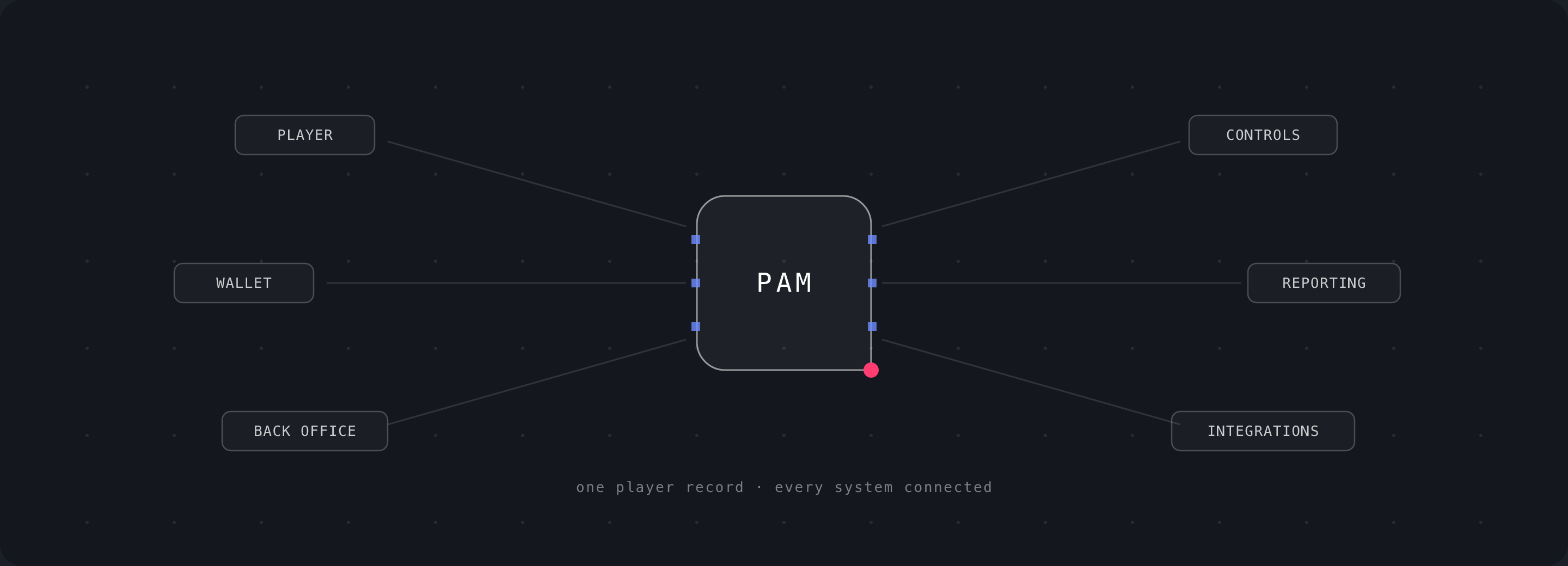
Player management, wallets, back-office controls, reporting and integrations work around the same platform foundation.
That matters because operations rarely stay static.
Markets change. New products are introduced. Brands expand. Requirements evolve.
The technology underneath needs to move with them.
That is the principle behind Flexi:
One platform. Built to adapt.